Welcome everyone to 2026 and also welcome to this, the traditional yearly transition blog post, in which I ramble a bit about what happened in the past year and what I would like to happen in the coming year.

Betty’s Bay sunset on the first day of 2026. Do note the HDR on display systems that support it. Thanks AVIF!
I am still pretending that the main audience for this post is me, a framing that helps tremendously with just publishing the damn thing, but of course it would make me super happy if anyone else finds anything of value or entertainment. That being said, please be warned that this post is one of the most discontinuous ones I’ve written in a while. All of that being said, everything you see here is 100% human-generated.
Writing
I spent most of 2025 stuck in a writing rut.
During the few un-rutted periods, one (1) transition post and five (5) regular WHV posts saw the light of the day, each one after an embarrassingly substantial amount of groaning and teeth gnashing.
What was quite consistent during the year, was my will to write blog-worthy (not a high bar, trust me) things. What was also consistent, and a saving grace, was my habit of jotting something down in my daily journal almost every day of the year.
Looking back at last year’s transition post’s writing section, it looks like the current situation is about equally dire.
However, just like every breath is a new beginning, this new year is a new opportunity to try again. It feels like it has only become more important that we humans find, and keep, our voices, in order to connect with other humans through a sea of AI-generated writing.
Reading
In stark but happy contrast to my writing habits, and as hinted to in March of this year, my “reading” did quite OK in 2025.
I have those quotes there, because the bulk of my non-fiction reading was in fact listening to audiobooks.
My favourite audiobooks were:
- Behave: The Biology of Humans at Our Best and Worst, by Robert M. Sapolsky
- Lights On by Annaka Harris, an audio production consisting of a number of interviews and discussions she conducted as research for her book Conscious: A Brief Guide to the Fundamental Mystery of the Mind.
- Being You by Anil Seth, which I insta-bought based on his appearance in Lights On, and which I wrote about in WHV 262 Beast Machine
- The Demon-Haunted World by Carl Sagan. Like many other (older) nerds, I am happy that Carl Sagan has been living rent-free in my head since I can remember, but I had not read this important book of his before. It’s a great if somewhat depressing read, because many of the bad things Sagan said would happen when we don’t teach our kids to live the scientific method, are in fact happening at full force as we speak.
We are like butterflies who flutter for a day and think it is forever.
– Carl Sagan
In terms of fiction, 2025 for me was resoundingly the year of Adrian Tchaikovsky.
I’m slightly embarrassed that I’ve only discovered him so late, but actually extremely fortunate, because now I have a whole bunch of his work to enjoy for the first time.
Each of the three editions of the Children of Time trilogy was a fantastic romp that blew my mind in different and wildly inventive ways. (Spider consciousness seemed positively prosaic by the time we arrived at Octopus consciousness…)
I felt Alien Clay particularly acutely, and thanks to the wondrous times that we find ourselves in, I was able to direct my admiration directly at the author on BlueSky and have him acknowledge. At the time of this writing, I’m enjoying Service Model and looking forward to more.
(I case you missed it, after a number of years on various Kindle e-readers, I’m now doing my reading on a Boox Go 6 android e-ink reader.
Running and exercise
My goals for 2025 were the same as for 2024: Go for an average 25km per week, but be really happy if you make 1200km over the year, an average of 100km per month.
I failed again, but I came somewhat closer to success this year than last year, in spite of both my Achilles tendons almost coming to a standstill in October. (They are almost but not quite back to normal as I sit here writing this.)
In 2025, I logged 1176.2km (23.8km short) of running spread out over 131 runs, spanning in total 110 hours and 20 minutes.
Adding up the few (mini) hikes I joined, that comes to a total of 1246.9km over 151 activities taking up 126 hours.
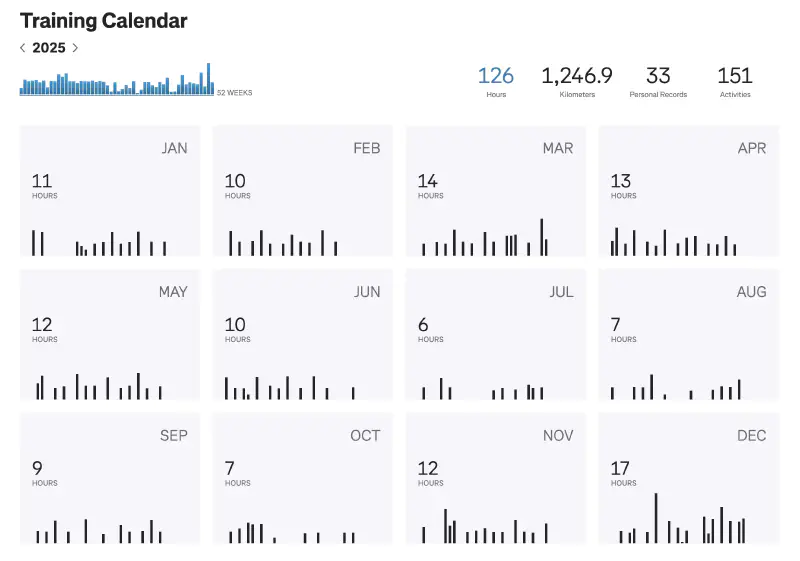
In the training calendar, you can see the impact of the winter months, the October Achilles struggles, and the December last ditch effort to get the numbers back up a bit.
THIS YEAR WE DO IT ALL AGAIN!
In May of 2025, my VO2 Max briefly hit the 50 goal due to happy accident (a bunch of really good runs in a row I guess, almost like One Punch Man’s “Consecutive Normal Punches”) before, slightly depressingly but not surprisingly, settling back down to 48 again, where I’ve been hanging out since then.
This year I hope to actually put some more concerted effort into that VO2 Max, not just “consecutive normal runs” as I’ve been doing up to now.
I said something similar last year, but this year I have a better plan and a new toy to help with that plan and maybe a bit more.
Ladies and gentlemen, I think I’m only just getting the hang of the snatch, but I’m cautiously quite excited about my newly acquired, and extremely affordable thanks to Mr Price Sports, 16 kg cast iron kettlebell.
You see, I’ve also been wondering how to better counter (and maybe partially reverse) my age-related strength decline. Besides the surprising discovery (to me) that HIIT with kettlebell snatches is a VO2 Max thing, this heavy chunk of cast iron is obviously much better than any stone when having to deal with two, or oven more birds, at once.
(I just learned that “two flies with one slap” seems to be culturally more widespread than the English “two birds with one stone”.)
P.S. It’s now more than a month after I wrote the above. My left Achilles has been acting up to such an extent that I have to take a slightly longer break from running, and so I have been getting to know the kettlebell a bit better. It is truly a fun piece of equipment, an often-underestimated success factor of sustainable exercise. It also doesn’t hurt that the exercises have fun names like “thrusters”, “snatches” and “uppercuts”! (FATALITYYYYYYYY!)
You are what you repeatedly do
I’ve spent a considerable number of mental cycles on the interesting problem of coming up with a good analogy for what I’m planning to say here, all to no avail.
Perhaps if I practised more often coming up with good analogies, things would be different.
To be honest however, although I respect their clear power and influence, I don’t really like analogies all that much, because they tend to give people a false perception that they understand the often more complicated issue that they attempt to proxy for.
During research for this section, I learned about Athletic Heart Syndrome, or AHS.
AHS sounds like it could be serious, but fortunately it’s an extremely benign condition, namely the normal, physiological adaptation of the body to the stresses of physical conditioning and aerobic exercise, which includes bradycardia (slower than normal resting heart rate, i.e. less than 60), cardiomegaly (enlarged heart) and cardiac hyperthrophy (thickening of the muscular wall of the heart).
In other words, your physiology adapts to your habits, in this case a pretty significant upgrade of your heart in order to pump more blood more efficiently to fuel for example a few hours of running every week. Because your heart adapts to this higher than sedentary (note I did not use the word “normal” here…) requirement, it is now able to cover the more relaxed parts of your life with far fewer beats per minute.
Diving into some recent(ish) literature, one also learns that:
exercise is not simply a way to generate a calorie deficit as an add-on to restrictive diets but exerts powerful additional biological effects via its impact on mitochondrial function, the release of chemical messengers induced by muscular activity, and its ability to reverse epigenetic alterations (Brun 2022)
More reading in the references mentioned here and elsewhere teaches us that being regularly active in actual fact upgrades one’s whole metabolism, down to the cellular level.
For example, both during exercise and even at rest, regularly active humans preferentially and more easily burn fat for energy, while sedentary metabolisms prefer glucose, practically ignoring the fat stores that are available (San-Millan 2024).
The list of exercise-induced physiological changes goes on.
I found the following observation quite poignant:
in modern societies, the normalization of the lack of physical activity has led to the perception that physical activity is an intervention even though it remains as the modus vivendi engrained in our genes; the reality is that becoming sedentary has been the real intervention and collateral effect of modern societies (San-Millan 2024)
All of this seems like a painfully mechanistic implementation of the principle of the usually more philosophical you are what you repeatedly do, while the quote at the end of the previous WHV feels like an ever-so-slightly shifted view of the same truth.
Traditionally closer to biology, and often invoked in neuroscience, there’s another version, namely our old friend use it or lose it. I don’t want to rehash too much of that story, but the plot is similar (quoting from WHV #212):
The moment you stop practising a certain (brain) function, like math, or absorbing technical documents, or programming, or driving, or running, or being kind, your system will start to try to repurpose as much as possible of the required subsystems for other functions that you are actively deploying.
Extremely fortunately, it turns out that it’s never too late to start (again), even when you’re pushing 90, as Dr Maria Fiatarone showed in the late 80s when she put a cohort of 90 year olds through a few weeks of strength training, resulting in walking speed gains of 50% on average, and literally stunning strength gains of 174% on average.
P.S. Back in WHV #20 (2010) I learned about epigenetics, another mechanism whereby what we do doesn’t only change us, it even changes our offspring. In WHV #70: Patterns in the sand, I tried to explain my changing perspective that, contrary to our subjective experience, we are just ripples in the fabric of reality.
References
- Brun, J.-F. et al. (2022) “Beyond the Calorie Paradigm: Taking into Account in Practice the Balance of Fat and Carbohydrate Oxidation during Exercise?,” Nutrients, 14(8). Available at: https://doi.org/10.3390/nu14081605.
- San-Millan, I. et al. (2024) “Metabolic and Cellular Differences Between Sedentary and Active Individuals at Rest and During Exercise.” bioRxiv, p. 2024.08.19.608601. Available at: https://doi.org/10.1101/2024.08.19.608601.
Life
I would like to preface this section, and hopefully not completely jinx myself, with the following:
Life is an unending series of complications, so it doesn’t make any sense to be surprised by the arrival of the next one.
Sam Harris
The year 2025 had its fair share of problems and challenges. During each of them, when I could remember the advice above, it helped to accept the apparently default state of having to resolve some new complication, or just having to survive the ordeal with as much grace as possible.
That same advice in fact also exhorts us to enjoy any moments of bliss as much as we possibly can. We were blessed with a number of those, many of them due to our amazing offspring units, the rest thanks to our family and friends. (Conclusion: your people are everything.)
ANYWAYS
This is the part where I also usually try and write something about my Life Systems (guiding principles, personal values, tips and so on). This time, I have nothing to add, as last year’s edition, creatively titled “Life Systems 2025” is still quite accurate for me.
If you don’t have time to read that, or your attention span is not spanning, I would summarize extremely lossily with: Love abundantly, apply science, work hard, party hard, rest hard, and… pay attention.
I wish you much love, reliable science, meaningful work, the best parties, serene rest, and many blissful moments in which to be maximally present.
The greatest obstacle to living is expectancy, which hangs upon tomorrow and loses today.
– Seneca